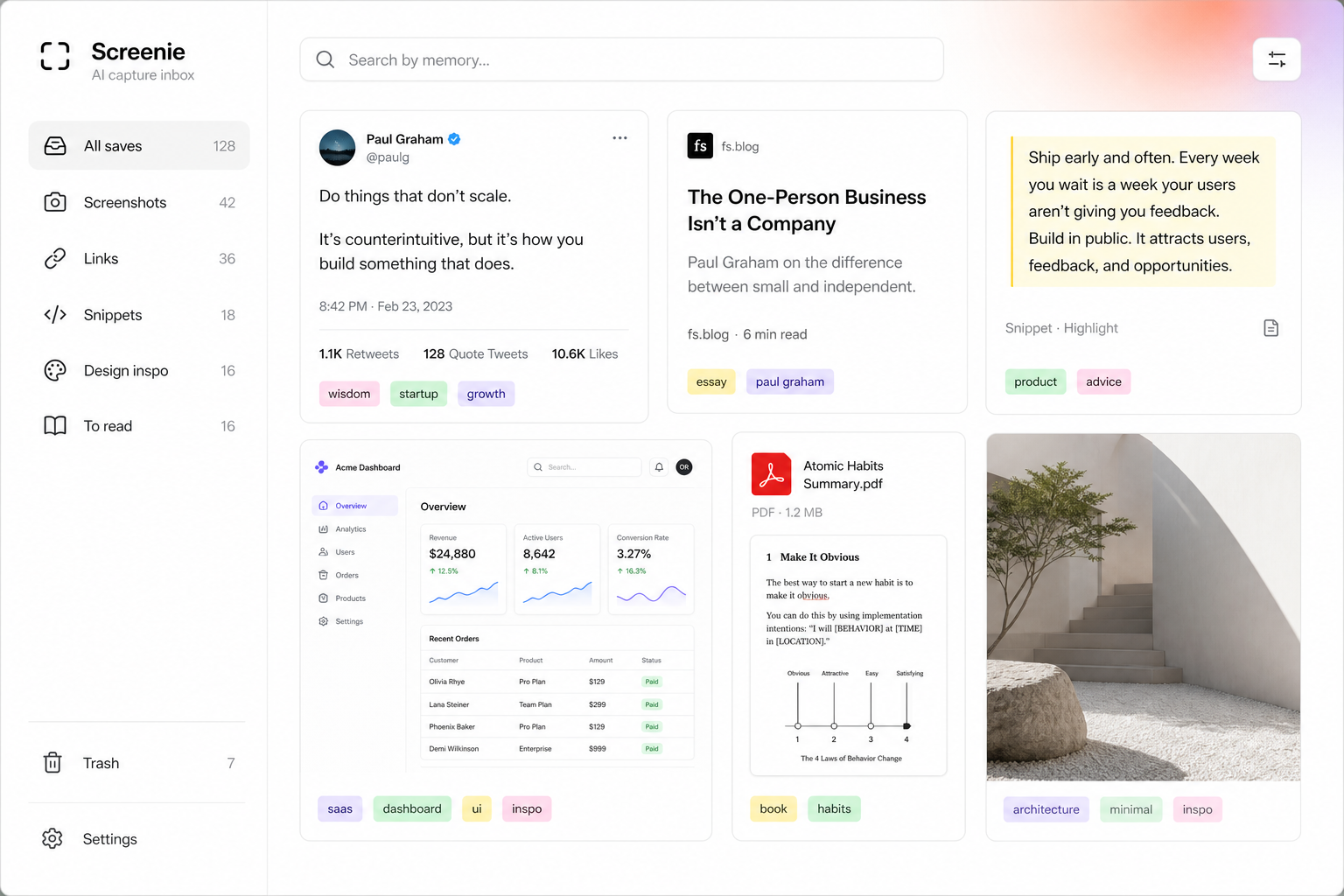
You created a folder called Design Inspiration in January. By March it has forty items, half unrelated, and you stopped opening it because deciding where new saves belong takes longer than saving them.
Folders fail because they require upfront certainty about how you will think later. You rarely have that certainty. You have a screenshot of a checkout flow and a vague sense it might matter for a project you have not named yet.
The best organization system is one you do not have to maintain on every save.
Capture first, cluster second
Screenie's default workflow:
- 1Everything lands in one inbox.
- 2AI reads each save — title, text, tags, context.
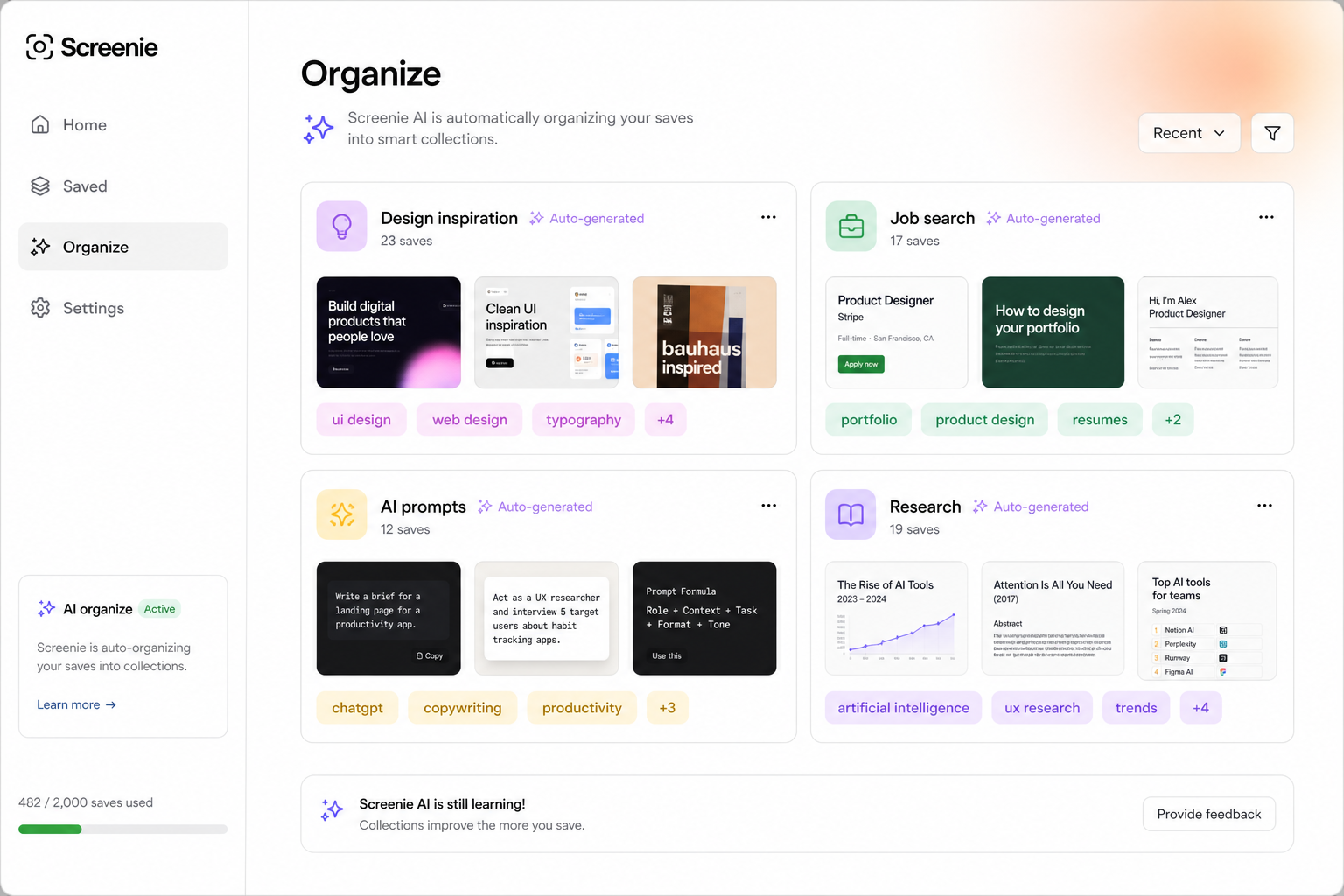
- 3Related saves drift together into collections you did not manually create.
You search when you need something specific. You browse collections when you want to see what accumulated around a topic.
When collections beat folders
Collections work when saves share:
- Similar vocabulary (pricing, onboarding, checkout)
- The same source domain or author
- Overlapping tags from AI analysis
- Proximity in time (everything from last week's research sprint)
You did not decide those groupings. They appeared because the content related itself.
What you still control
Auto-collections are not magic — you can:
- Pin a collection when it becomes a project
- Merge duplicates after a big import
- Rename for clarity when sharing with a team
The difference: maintenance happens occasionally, not on every save.
Pair with memory search
Collections are for browsing. Search by memory is for retrieval. Together they replace the folder tree you never kept current.
If you are building a second brain without a system, collections are how recall scales without filing rituals.
The point
Stop pre-sorting. Start capturing. Let related saves find each other.
Join the waitlist and see what clusters around your next week of saves.